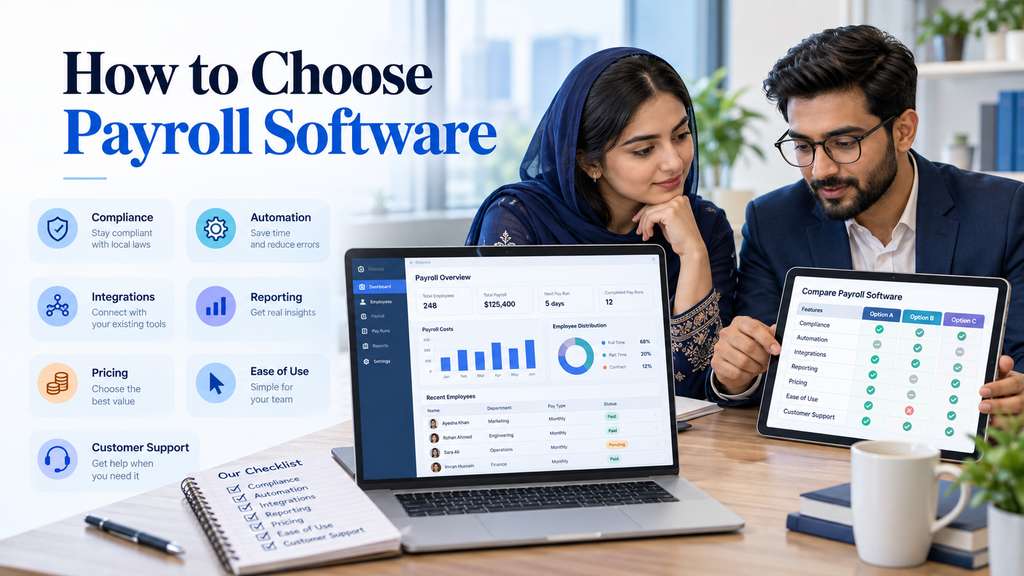

How to choose payroll software tends to come up at an awkward moment: the month a spreadsheet gives someone the wrong salary. Up to a certain size, manual payroll limps along. Add overtime, mid-month joiners, loan deductions, and festival bonuses, and the sheet becomes a risk nobody wants to own.
For businesses searching for payroll software in Bangladesh, the choice is harder than it should be. Vendor websites read alike, demos are polished, and every plan promises accuracy. The real differences hide in boring places, like how a system treats a half-month salary or what it does when tax rules change.
This guide walks through the decision in the order that saves the most trouble: the business itself first, then features, local rules, cost, security, and growth, and finally the questions that make vendors slow down. Nothing here needs technical knowledge. A list of current pain points and a few real payroll cases are enough to compare options fairly.
Write Down How Payroll Works Today
Before watching a demo, spend an hour on paper. How many people are on payroll now, and how many next year? Which pay elements exist beyond basic salary, such as house rent, transport, overtime, commissions, or two annual bonuses? Where do mistakes usually creep in, and who signs off at the end?
Those answers become the scorecard. Without them, every demo looks impressive, because nothing has been defined as important.
How to Choose Payroll Software: The Features Worth Testing
Feature lists are long. Only a few items decide whether payroll runs smoothly.
The calculation engine comes first. It should handle pro-rated pay for joiners and leavers, loan and advance recoveries, and different salary structures for different grades, all without anyone overriding numbers by hand. Hand the vendor three or four awkward cases from last year and ask for results on screen.
Attendance and leave matter nearly as much. When overtime hours and unpaid leave flow straight into payroll, nobody retypes them, and retyping is where most errors start.
Approvals deserve a look too. A proper flow from preparation to review to release, with a log of who changed what, explains any figure that moves later.
Then come the employee-facing pieces: payslips on a phone, and reports finance can export without a favor from IT.
Local Rules Come First
Software built for another country can look flawless and still get local payroll wrong. For companies in Bangladesh, checks include income tax deductions at source, provident fund or similar contributions, overtime under local labour rules, and festival bonus handling.
Ask how rate tables get updated and who does it. Automatic updates from the vendor are one thing. A system that expects the customer to edit tax slabs every year quietly moves risk back to the business.
Scope matters too. Some firms need only payroll, while others look at HR software in Bangladesh that adds attendance, leave, and employee records. A full HRIS software in Bangladesh goes further and keeps the whole employee file in one place.
For anyone working out how to choose payroll software for a local company, compliance deserves the most weight. Rules change, so confirm final details with an accountant.
Cost, Beyond the Monthly Fee
Sticker price tells only part of the story. Some vendors charge per employee, others a flat fee, and the gap widens as headcount grows. Setup, data migration, and training may be billed separately, and modules like attendance can cost extra.
When thinking about how to choose payroll software on a tight budget, compare twelve months of total cost, including everything that will realistically be used.
Support, Security, and Room to Grow
Payroll data is among the most sensitive a company holds. Role-based access keeps managers from seeing salaries outside their teams, and backups plus an audit trail matter. Find out where the data lives and how it can be exported if the contract ends.
Support is the other half. Check hours, languages, and response times, and whether a real person handles onboarding.
Growth is easy to overlook, too. A system that fits twenty employees may strain at sixty, so ask what doubling in size would do to the software and the bill.
Questions That Expose a Weak Vendor
Good vendors answer these without hesitation. Can a trial run use the company’s actual salary structure? How quickly do tax changes reach the system? How long does onboarding take? Which clients are similar in size? Can all data be exported?
Slow or overly polished replies are worth noting, as is pressure to sign before a trial. These moments are where learning how to choose payroll software turns from features into trust.
A Sensible Order of Steps
Here’s how to choose payroll software without drowning in options. Start with the written list of needs, shortlist three vendors, and give each the same test cases. Add up a year’s cost, check a couple of references, and try support with a real question.
After deciding, run old and new systems in parallel for one full cycle. Mismatches are cheaper to find in a test run than in someone’s salary.
Frequently Asked Questions
Q) What is the difference between payroll software and HRIS software in Bangladesh?
Ans: Payroll software calculates salaries, deductions, and payslips. An HRIS usually covers that and more, such as employee records, attendance, and leave. Businesses that only need salary processing can start small and add modules later.
Q) Can HR software in Bangladesh handle festival bonuses and local tax deductions?
Ans: Many systems claim to, but it varies by product. Ask for a live demo using a real bonus and tax case, and confirm how rate updates are delivered. An accountant should verify the results.
Q) How long does it take to start using new payroll software in Bangladesh?
Ans: It depends on headcount, data quality, and setup needs. Plan for data cleanup, test runs, and at least one parallel payroll before switching fully.
Final Verdict
No payroll system is perfect, so the goal is a good fit, not a flawless one. Write down how salaries are really paid, test every shortlisted vendor on the same awkward cases, and treat local compliance as non-negotiable. Read the price list to the last line and judge support by how it behaves before the sale.
Anyone still wondering how to choose payroll software can lean on that routine and ignore the rest. Keep the old records until a parallel run matches the last taka. After that, payday should feel routine, and HR can spend its time on people instead of cells.