
When Johannes Gutenberg introduced the movable-type printing press in the 15th century, he didn’t just invent a machine—he engineered a revolution. For the first time in human history, information could be mass-produced, democratizing knowledge and accelerating the Renaissance, the Scientific Revolution, and the Reformation.
Today, we stand in the midst of another seismic shift in printing. While physical books and newspapers face stiff competition from screens, the industry itself is far from obsolete. Instead, it has morphed into a sophisticated, highly adaptable powerhouse that bridges the physical and digital worlds.
The Digital Takeover: From Analog to On-Demand
For decades, offset printing reigned supreme. It was—and still is—the gold standard for massive print runs where economy of scale lowers the cost per unit. However, the rise of digital printing changed the rules of the game entirely.
Digital technology eliminated the need for cumbersome metal plates. Files go straight from a computer screen to the press, enabling:
- Short-run and on-demand printing: Publishers and businesses no longer need to warehouse thousands of copies that might never sell. They can print 50 copies today and 500 next week.
- Variable data printing (VDP): Every single piece coming off the press can be uniquely customized with different names, addresses, or targeted imagery, transforming direct mail from generic junk into a personalized conversation.
- Faster turnaround times: What used to take days of setup can now be prepped and printed in hours.
Beyond Paper: The Rise of Speciality and 3D Applications
If you think printing is just about putting ink on paper, you are missing half the picture. The modern landscape extends far beyond the traditional page into astonishing new dimensions.
Wide-Format and Industrial Graphics
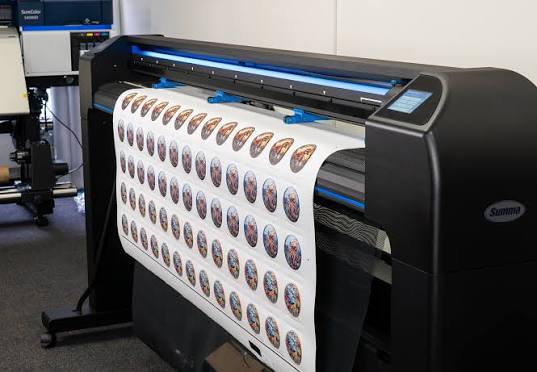
Walk down any high street, and you will see the impact of modern wide-format printing. Vehicle wraps, massive building banners, tactile wall coverings, and durable outdoor signage rely on UV-curved inks that resist fading and weathering. This sector treats physical spaces as canvases, turning architecture into advertising and art.
Textile and Apparel
The fashion industry has embraced digital textile printing to minimize waste and maximize creativity. Designers can print intricate patterns directly onto silk, cotton, or polyester with vibrant colors and complex gradients that traditional screen printing struggled to achieve efficiently. It also enables sustainable, just-in-time manufacturing for independent clothing brands.
Three-Dimensional Manufacturing
Perhaps the most futuristic extension of the concept is 3D printing, or additive manufacturing. By building objects layer by layer from polymers, metals, and even bio-inks, this technology has disrupted aerospace, automotive manufacturing, and healthcare. Surgeons now use 3D-printed anatomical models to plan complex operations, while aerospace engineers print lightweight titanium brackets that reduce fuel consumption.
Sustainability and the Eco-Friendly Press
For a long time, the environmental footprint of the graphic arts industry was a cause for concern. Solvent-based inks, petroleum-derived plastics, and paper waste cast a long shadow.
Fortunately, the industry has aggressively course-corrected. Modern eco-friendly printing utilizes:
- Soy and vegetable-based inks: These emit far fewer volatile organic compounds (VOCs) than petroleum counterparts and make paper recycling significantly easier.
- FSC-certified and recycled stocks: Sourcing paper from responsibly managed forests ensures that the medium supports environmental stewardship rather than deforestation.
- Energy-efficient LED-UV curing: This technology dries ink instantly using light rather than heat, drastically cutting energy consumption during production.
The Enduring Power of the Printed Page
Despite the ubiquity of smartphones, tablets, and e-readers, tactile media retains a psychological power that digital formats struggle to replicate. Cognitive studies consistently show that people retain information better when reading it on paper rather than a screen. There is an emotional resonance to holding a physical book, opening a luxury product packaging box, or receiving a textured, foil-stamped business card.
The future of printing isn’t about competing with digital media; it is about integration. With embedded near-field communication (NFC) chips, augmented reality (AR) triggers on packaging, and conductive inks that light up paper circuits, the printed medium is becoming interactive.
Gutenberg gave humanity a voice through ink and metal. Today, modern printing ensures that voice remains louder, greener, and more versatile than ever before.


